

Table of Contents
Введение
If you are new to programming or trying to pick the right language for a project, you have likely come across both C and C++. They look similar on the surface, but they work quite differently.
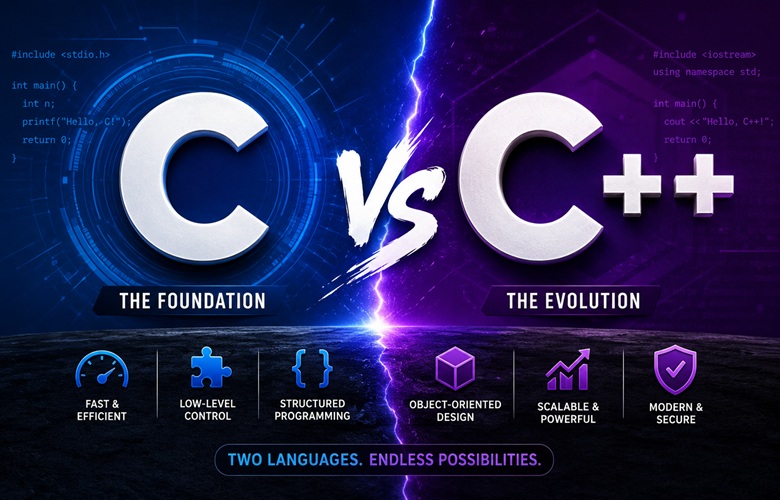
C is one of the oldest and most respected programming languages in the world. C++ was built on top of it. But that does not mean one is better than the other. Each has its own strengths depending on what you are building.
In this article, we break down the differences between C and C++ in simple terms so you can make a clear decision.
What Is C?
C is a general-purpose programming language created by Dennis Ritchie in 1972 at Bell Laboratories. It was originally built to develop the Unix operating system.
C is a procedural language, which means your code runs step by step through functions. There are no classes or objects. Everything is structured around functions and data.
Today, C is still heavily used in:
- Operating systems (Linux, Windows kernel)
- Embedded systems
- Device drivers
- Hardware programming
C is fast, lightweight, and very close to how a computer actually works at the hardware level.
What Is C++?
C++ was created by Bjarne Stroustrup in 1979. It started as “C with Classes” and was renamed C++ in 1984.
C++ is a superset of C, which means almost all valid C code also works in C++. But C++ goes further. It adds object-oriented programming (OOP) features like classes, objects, inheritance, and polymorphism.
C++ is widely used in:
- Game development (Unreal Engine is built in C++)
- High-performance applications
- GUI applications
- Financial systems
- Browsers (Google Chrome uses C++)
C vs C++: Main Differences
Here is a clear breakdown of how the two languages differ:
1. Programming Style
C uses procedural programming. You write code as a sequence of instructions inside functions.
C++ supports both procedural and object-oriented programming. You can use classes and objects to organize code into reusable building blocks.
For large and complex projects, OOP makes code easier to manage and scale.
2. Classes and Objects
C does not support classes or objects at all. Data and functions are kept separate.
C++ allows you to create classes that bundle data and functions together. This is the foundation of OOP and makes code much more organized.
3. Memory Management
Both languages let you manage memory manually. In C, you use malloc() and free(). In C++, you use new and delete.
C++ also supports constructors and destructors, which help manage memory automatically when objects are created or destroyed. This gives C++ an edge when handling complex data structures.
4. Exception Handling
C does not have built-in exception handling. You have to use error codes and check them manually.
C++ has a proper try, catch, and throw system for handling errors. This makes your code cleaner and easier to debug.
5. Function Overloading
In C, every function must have a unique name.
C++ allows function overloading, meaning you can have multiple functions with the same name as long as they take different parameters. This makes code more intuitive.
6. Standard Libraries
C uses a simpler standard library. The default header file is stdio.h.
C++ has a much richer standard library, including the Standard Template Library (STL), which provides ready-made data structures like vectors, stacks, queues, and maps. The default header in C++ is iostream.
7. Type Safety
C is less strict about types. You can implicitly convert between types in ways that may cause bugs.
C++ enforces stricter type safety, which helps catch errors at compile time before your program runs.
8. Inline Functions
C does not support inline functions. It typically uses macros for performance optimization.
C++ supports inline functions, which can speed up execution by replacing function calls with the function body directly in the compiled code.
9. Learning Curve
C is simpler and easier to learn for beginners. The syntax is clean and there are fewer concepts to grasp.
C++ has more features, which means a steeper learning curve. But once you understand C, picking up C++ becomes much easier.
10. Number of Keywords
C has 32 keywords. C++ has 63 keywords, reflecting its larger feature set.
Quick Comparison Table
| Feature | C | C++ |
| Type | Procedural | Procedural + OOP |
| Classes & Objects | No | Yes |
| Exception Handling | No | Yes |
| Function Overloading | No | Yes |
| STL Support | No | Yes |
| Inline Functions | No | Yes |
| Keywords | 32 | 63 |
| Default Header | stdio.h | iostream |
| Memory Management | malloc/free | new/delete + constructors |
| Learning Curve | Easier | Moderate to Hard |
C vs C++: Performance
Both languages are fast. C is often considered slightly faster in raw terms because it has fewer abstractions. The compiler does not need to handle OOP overhead.
But C++ is designed to be just as efficient when written correctly. Modern C++ compilers are very good at optimizing code. For most real-world applications, the performance difference between C and C++ is not significant.
If you are working in an environment with very limited resources, like a microcontroller with 8KB of RAM, C may be the better choice. For everything else, C++ performs extremely well.
When to Use C
Use C when you need:
- Direct hardware access and low-level control
- Minimal memory footprint
- Systems programming (OS kernels, bootloaders)
- Embedded devices with limited resources
- Portability across very old or constrained hardware
Good examples of software written in C: Linux kernel, SQLite, Python interpreter, Git
When to Use C++
Use C++ when you need:
- Object-oriented design for large codebases
- Game development or graphics-heavy applications
- High-performance software with complex data structures
- Financial or trading systems
- Cross-platform applications with rich functionality
Good examples of software written in C++: Google Chrome, Adobe Photoshop, Unreal Engine, MySQL
Can C Code Run in C++?
Almost always, yes. Since C++ is a superset of C, most C programs will compile and run in a C++ compiler with little to no changes. This makes it easy to gradually move a C project to C++ if needed.
However, there are some edge cases where C code may not compile in C++ due to stricter type rules in C++.
Should Beginners Start with C or C++?
This is one of the most common questions new programmers ask. Here is a straightforward answer:
Start with C if you want to understand how computers work at a low level. It teaches memory management, pointers, and how programs interact with hardware. These are skills that make you a better programmer in any language.
Start with C++ if your goal is game development or software engineering and you want to learn OOP from the beginning.
Either way, learning one makes it much easier to learn the other. Many universities still teach C first for exactly this reason. If you want to explore structured learning paths, resources like GeeksforGeeks C Programming Guide and cppreference.com are excellent references.
C vs C++: Similarities
Despite all the differences, C and C++ share a lot:
- Nearly identical syntax and operators
- Both are compiled languages
- Both support pointers and manual memory management
- Both are platform-independent when written correctly
- Both have excellent performance compared to interpreted languages
- Both are widely supported with large communities
FAQs About C vs C++
Yes, largely. C++ was built as an extension of C. It keeps all of C’s core features and adds object-oriented programming, templates, exception handling, and a much richer standard library.
In theory, C can be slightly faster due to fewer abstractions. In practice, well-written C++ code performs at a very similar level. Modern C++ compilers are highly optimized.
C is simpler because it has fewer concepts. C++ has a steeper learning curve due to OOP, templates, and a larger standard library. Most developers recommend learning C first.
Yes. C++ has built-in support for C libraries. You can use extern “C” to include C code in a C++ project without compatibility issues.
C is traditionally preferred for system programming because of its low-level access and minimal overhead. However, C++ is also used in systems programming and offers more tools for organizing large codebases.
Absolutely. C remains one of the most used languages in the world. The Linux kernel, embedded firmware, and countless tools are still written in C. It is not going away anytime soon.
Final Thoughts
C and C++ are both powerful and both worth knowing. They are not competitors. C++ grew out of C and the two languages continue to evolve side by side.
If you need raw control over hardware and simplicity, go with C. If you are building a large application that benefits from object-oriented design, C++ is the right tool.
Understanding both will make you a stronger developer no matter what path you take. For further reading on C++ features and standards, visit the official ISO C++ website or check the C++ reference on cppreference.com.
Published on iTech Magazine — Your source for technology news, programming guides, and developer resources at itechmagazine.com
