

Table of Contents
If you have ever wondered who is watching over a company’s digital systems at 3 AM, it is a SOC analyst. They are the people who catch hackers before the damage spreads. As cyber attacks grow more frequent and costly, this role has become one of the most important in tech.
This guide covers everything you need to know about the SOC analyst role: what they do daily, how the three tiers work, what skills you need, certifications worth getting, and what you can earn.
What Is a SOC Analyst?
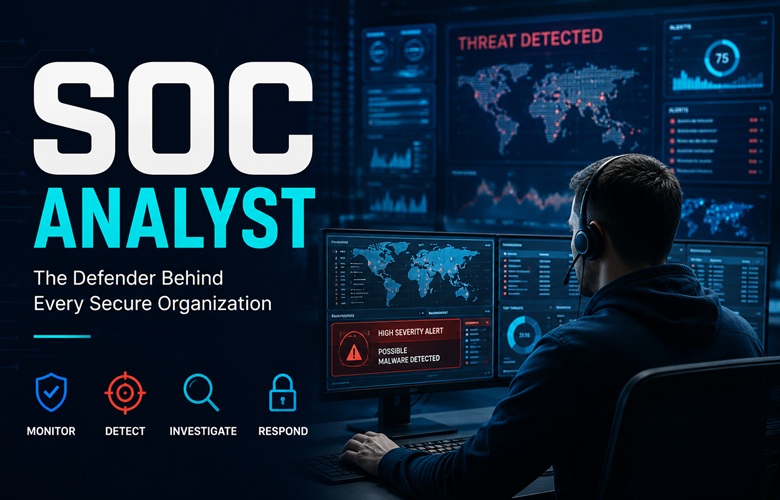
A SOC analyst (Security Operations Center analyst) is a cybersecurity professional who monitors, detects, and responds to threats targeting a company’s networks, systems, and data. They work inside a Security Operations Center, which is the dedicated team and workspace built to defend an organization around the clock.
Think of a SOC as the control room for cyber defense. SOC analysts are the people staffing it, watching dashboards, reviewing alerts, and deciding which threats are real and which are false alarms.
The role exists because the number of attacks has grown far beyond what any single security tool can handle alone. Human judgment is still needed to make the call.
How the Three Tiers Work
Most SOC teams are divided into three tiers, each with different responsibilities and experience levels.
Tier 1 – Alert Monitoring and Triage
Tier 1 analysts are usually the first in the door. Their main job is to watch incoming alerts and decide which ones need attention. They sort real threats from false positives and escalate anything serious to Tier 2. This tier requires solid knowledge of operating systems like Windows and Linux and basic scripting skills.
Tier 2 – Incident Response
When Tier 1 escalates an alert, Tier 2 takes over. These analysts dig into the full attack chain, look at logs, gather context, and respond to confirmed security incidents. They assess how far an attack has spread and what systems were touched. This is where deeper investigation skills matter.
Tier 3 – Threat Hunting and Advanced Analysis
Tier 3 analysts are the most senior. They do not wait for alerts to come to them. Instead, they actively go looking for threats that have already bypassed existing security tools. They also run security assessments, test for vulnerabilities, and help improve the overall detection setup. Some Tier 3 analysts move into leadership roles or specialize in areas like threat intelligence or forensics.
What Does a SOC Analyst Do Each Day?
The daily work of a SOC analyst is more hands-on than most people expect. A typical shift looks something like this:
At the start of a shift, analysts review overnight alerts and read handoff notes from the previous team. They check what is still open, what was escalated, and what was resolved.
During the shift, they monitor dashboards, investigate suspicious activity, and use tools like SIEM (Security Information and Event Management) platforms to track events across the network. When an alert comes in that looks like a real threat, they investigate it, document what they find, and either resolve it or pass it up the chain.
At the end of the shift, they write up incident reports and hand off anything still open to the next team.
The reality is that the volume of alerts is high. A large organization can generate thousands of alerts per day, and separating real threats from noise takes skill and practice.
Key Skills a SOC Analyst Needs
1:Technical Skills
SIEM expertise is the most requested skill in SOC analyst job postings. Platforms like Splunk, Microsoft Sentinel, and IBM QRadar are widely used, and knowing how to work inside them is nearly required.
Other important technical skills include:
Network monitoring and traffic analysis to understand what normal activity looks like and spot what does not fit. Knowledge of firewalls, intrusion detection systems (IDS), and endpoint detection and response (EDR) tools. Scripting in Python or similar languages to automate repetitive tasks. Log analysis to trace activity across systems and find the source of a problem. Threat intelligence to understand current attack methods and who is behind them.
2: Soft Skills
SOC work is not just technical. Analysts need to communicate clearly, especially when explaining a security incident to non-technical managers or stakeholders. Staying calm under pressure is important because real incidents can be stressful and fast-moving. Attention to detail matters because a small clue in a log file can be the difference between catching an attack early and missing it completely.
3: AI and Automation Skills
This is newer but growing fast. More than 64% of cybersecurity job listings in 2025 mention AI, machine learning, or automation skills. SOC analysts who can work alongside AI-driven tools and verify their outputs are becoming more valuable. AI handles the repetitive sorting; humans handle the judgment calls.
Best Certifications for SOC Analysts
You do not always need a degree to break into this field. Many employers care more about certifications and hands-on skills. Here are the ones worth knowing:
CompTIA Security+ is the best starting point. It is vendor-neutral, widely recognized, and often listed as a minimum requirement for government and contractor roles.
CompTIA CySA+ (Cybersecurity Analyst) is a natural next step. It focuses directly on threat detection and analysis, which is exactly what SOC analysts do.
Certified SOC Analyst (CSA) from EC-Council is built specifically for this role and covers everything from log management to SIEM use.
GIAC Security Essentials (GSEC) is well-respected in the industry and covers a broad range of security topics at an intermediate level.
Splunk Core Certified User is worth getting if your target employer uses Splunk, which many do. Vendor-specific certifications show you can hit the ground running.
Platforms like TryHackMe, HackTheBox Academy, and LetsDefend offer hands-on labs that are excellent for building real skills before landing your first job.
SOC Analyst Salary: What to Expect
Pay varies by tier, location, and experience, but the numbers are strong across the board.
1: Tier 1 analysts typically earn between $55,000 and $80,000 per year.
2: Tier 2 incident responders generally fall in the $80,000 to $110,000 range.
3: Tier 3 threat hunters and senior analysts can earn $100,000 to $140,000 or more. Senior SOC managers and team leads often earn $120,000 to $160,000 and above.
Industries like finance, healthcare, and defense tend to pay more. Having cloud security skills, active certifications, or a security clearance also pushes salaries higher. Remote work has expanded as well, with 40 to 50% of SOC roles now offering remote or hybrid options, which means you are not limited to high cost-of-living cities to find well-paying work.
The SOC Analyst Career Path
Starting as a Tier 1 analyst is the most common entry point. From there, the path can go in several directions depending on your interests:
1: You can move up through the tiers, going from alert triage to incident response to threat hunting.
2: You can specialize in a specific area like digital forensics, cloud security, or red teaming. You can move into management as a SOC lead, SOC manager, or eventually CISO (Chief Information Security Officer). Each direction requires building new skills, but the SOC is one of the best starting points in cybersecurity because it gives you broad exposure to how attacks work and how defenders respond.
The Real Challenge: Alert Fatigue and Burnout
This is worth talking about honestly. The SOC analyst role is demanding. The volume of alerts can be overwhelming, and the pressure of knowing that a missed threat could cause serious damage is real.
Research shows that burnout is a major issue in this field. About 71% of SOC analysts report some level of burnout, and nearly 64% say they spend more than half their time on manual tasks they believe could be automated.
The good news is that AI and automation are starting to change this. SOAR (Security Orchestration, Automation and Response) platforms are taking over the most repetitive Tier 1 tasks, auto-closing obvious false positives and enriching alerts before a human reviews them. This should reduce some of the manual load over time.
If you want to stay healthy in this career, look for teams that invest in good tooling, rotate shifts fairly, and take analyst wellbeing seriously during the hiring process.
How AI Is Changing the SOC Analyst Role
AI is not replacing SOC analysts. It is changing what they spend their time on. Tools powered by AI are handling the rote lookups, flagging patterns in large datasets, and closing out the obvious noise. What is left for humans is the complex judgment work: deciding whether a pattern is truly malicious, understanding the attacker’s likely intent, and making response decisions that carry real consequences.
The analysts who will thrive are those who learn to work with these tools, know how to ask the right questions of AI systems, and can verify the outputs. The skill set is evolving, but the need for skilled humans in the loop is not going away.
How to Start as a SOC Analyst
You do not need years of experience to break into this field. Here is a practical starting point:
Build your knowledge with free or low-cost platforms. TryHackMe has a SOC Analyst learning path that walks you through the fundamentals with hands-on labs. Start with CompTIA Security+ for your first certification. It signals foundational knowledge and is respected across the industry. Set up a home lab. Practice analyzing logs, running Wireshark to look at network traffic, and using free SIEM tools. Document your work publicly. A blog post or write-up about a lab exercise shows employers you can do the work, not just pass a test. Apply broadly. Many companies hire junior analysts even without a degree, as long as you can show real skills and certifications.
The U.S. Bureau of Labor Statistics projects 32 to 33% growth for information security analyst roles through 2033, well above average for any profession. The demand is real and it is growing.
Frequently Asked Questions
A SOC analyst monitors an organization’s networks and systems for security threats. They review alerts, investigate incidents, and respond to attacks to limit damage. They work in shifts to provide 24/7 coverage.
Not necessarily. Many employers care more about certifications like CompTIA Security+ and hands-on skills than a formal degree. A degree in computer science or IT can help, but it is not always required.
1: Tier 1 analysts handle alert monitoring and triage.
2: Tier 2 analysts investigate and respond to confirmed incidents.
3: Tier 3 analysts proactively hunt for hidden threats and run security assessments.
Each tier requires more experience and deeper skills.
Common tools include SIEM platforms like Splunk and Microsoft Sentinel, endpoint detection and response (EDR) tools, intrusion detection systems (IDS), and threat intelligence feeds. Scripting in Python is also commonly used.
Entry-level analysts typically earn $55,000 to $80,000 per year. Senior and Tier 3 analysts can earn $100,000 to $140,000 or more. Salaries vary by location, industry, and certifications.
Yes, if you enjoy problem-solving and working in a fast-moving environment. The pay is strong, job growth is high, and the SOC is one of the best entry points into a long cybersecurity career. Burnout is a real concern, so choosing a team with good tooling and culture matters.
Looking for more guides on cybersecurity careers and tech roles? Browse iTech Magazine for the latest in technology trends, tools, and career insights.
